Any experienced client of a betting company can find the right value bet based on their knowledge. Correct risk assessment is extremely important when placing bets. In this article, we will explore this very interesting topic.
What Are Value Bets in Bookmakers?
What makes every sports match incredibly exciting to watch (even without betting) is its unpredictability. None of us can know the exact outcome in any sport. Bookmakers use various programs that analyze statistics to determine odds, aligning with the global market. But ultimately, anything is possible in sports, so bettors have the opportunity to find and gain an edge over bookmakers every day by selecting the right markets.
Value bets are wagers that provide the player with profit over the long term. When making value bets, bettors pay attention to factors such as:
- Form;
- Tournament standings of the opponents;
- Head-to-head results;
- Bookmaker odds.
Value bets require a special approach. In many cases, this approach is completely opposite to what the player is accustomed to. Here, odds take center stage. Some argue that you don’t need to know anything about the team you’re betting on if the odds give you a mathematical chance of winning.
Example of a Value Bet
How does this work in practice? For example, let’s take a match in the German Championship between Bayer and Bayern. Let’s focus on the odds for Under (3.5):
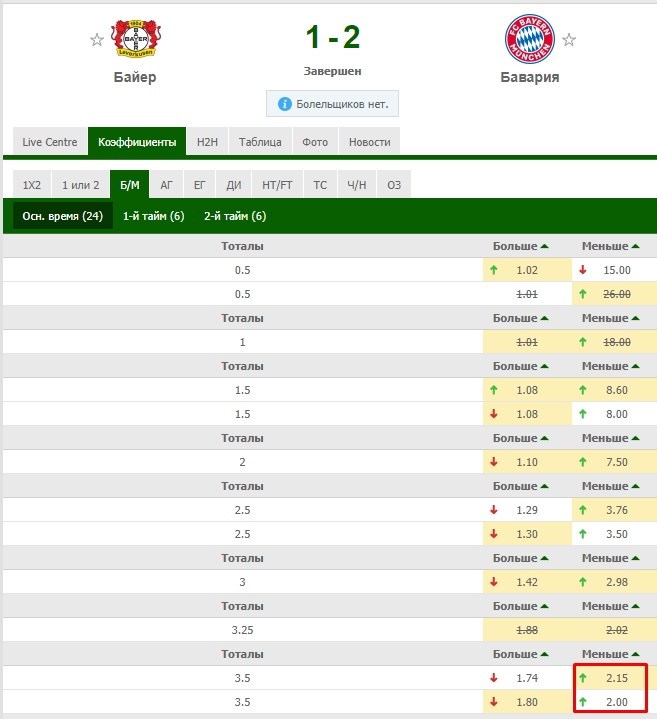
As we see, the odds start at 2. Now, let’s look at the results of the teams’ recent games and note the matches where Under (3.5) occurred:
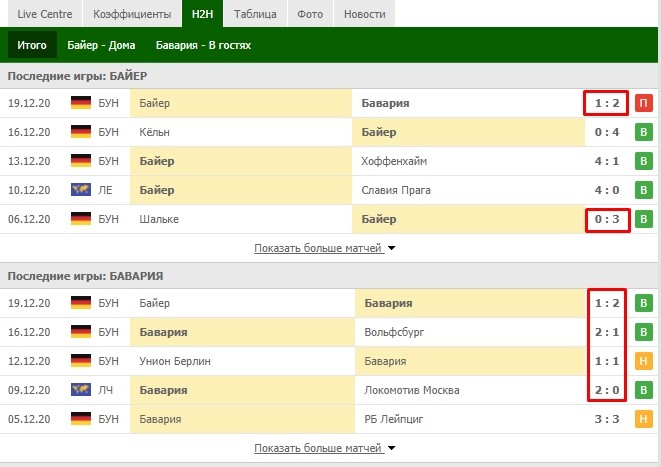
We see that Bayern had 4 out of 5 such matches, and Bayer had 2. Averaging the teams’ values, we get 60% of ‘low-scoring games.’ Converting this to odds gives: 100/60 = 1.66. Bookmakers, however, offer odds above 2. So, we’ve found that value.
What was the final score between Bayern and Bayer? The match ended with a 2:1 win for the Munich team, and the bet succeeded. Lewandowski scored the decisive goal in the final minute. Thus, we identified a bet with an edge over the bookmaker.
Odds and Bets. Why do these odds appear? It’s simple: bookmakers set odds based on the money wagered and bettors’ expectations. As we know, the German Championship is known for its high-scoring games. Here, the leaders are facing off. Naturally, most bettors go for over, despite Bayern’s recent games not often exceeding 3 goals.
Remember, odds in bookmakers are a key element in balancing the money wagered by clients. For bookmakers, it’s essential to maintain equilibrium between the amounts bet on each side and the odds to secure their margin. In other words, they profit from every position, regardless of the final score.
Chances with a Coin Toss
When you flip a coin, there are two outcomes: heads or tails. We know that the probability of either result is exactly 50%, which equates to odds of 2. In calculating odds, we use the formula:
odds = 1 / probability (from 0 to 1).
In this case, we get: 1 / 0.5 = 2. Now, imagine someone offers odds of 2.1 for tails and 2 for heads. Different bookmakers might offer this. Since the probability of either outcome is the same, it makes sense to bet on the side with the higher odds. Here, the market with odds of 2.1 is the value bet.
How to Identify a Value Bet?
Finding value markets in sports betting isn’t as hard as it seems. Of course, there are no coin toss situations, because in sports, we can’t know the exact probability of any outcome for sure.
Don’t think that bookmakers use complex programs that let them create perfect odds. And certainly, no bookmaker predicts one sport better than another. In reality, operators don’t care about the sport; they profit from each one. Here’s the formula that describes the balance of sums for bets and odds:
K1*S1 = K2*S2
Here, K1 and K2 are the odds for a two-outcome event, and S1 and S2 are the amounts wagered on each. For three outcomes, another product is added. As you can guess, the formula doesn’t account for the sport or the teams’ current form—only two parameters: odds and amounts. The more money is wagered on one side, the lower the odds, and vice versa.
We’re getting to the main question: what events are called value bets. From everything said before, the answer is clear—those with high odds. When the chances of an event don’t match the bookmaker’s odds. In such cases, we talk about overvalued odds. But they’re overvalued not due to operator errors, but because of the large amounts bet by players on the opposite side.
Odds Changes. It’s easy to see that odds in bookmaker lines are adjusted. It’s especially fascinating to watch odds change in live betting. This is a normal situation when player money flows push the odds. Don’t forget about that balance.
Some bookmakers change odds for marketing reasons, or, say, when they notice players like to bet on unrealistic outcomes, which usually have high odds. As a result, there will always be discrepancies in the odds offered by bookmakers. This means opportunities for value bets in different books, where you can profit, arise constantly.
Useful Information on Value Bets
Matches where two teams play, and one is a clear favorite, are a great source of value bets because bookmakers fear large payouts if the favorite wins. Odds for victories of big clubs like Juventus, Bayern, Barcelona, or Real are rarely low. As a result, you can find value for teams playing against these giants.
Bookmakers know that bettors prefer to bet on favorites, so they lower the odds for their win and raise the odds for the other team’s victory (maintaining that balance between bet amounts and odds). Don’t change your strategy, even if you lose a bet several times in a row. Remember, one win can outweigh several losses.
Kelly Criterion for Value Bets
It’s logical to ask how to calculate bet sizes. Since we’re talking about valuable markets, the Kelly Criterion comes to mind immediately. This is a well-known financial strategy that helps a player determine the bet size based on the bookmaker’s odds.
What’s the connection between value markets and the Kelly Criterion? Bettors estimate the chances of an event occurring, convert it to odds, and compare it to the bookmaker’s odds. If the calculated value is lower than the bookmaker’s odds, it’s a value bet. For easy bet calculations, a special calculator is used. The bettor fills in all the fields and gets the wager amount.
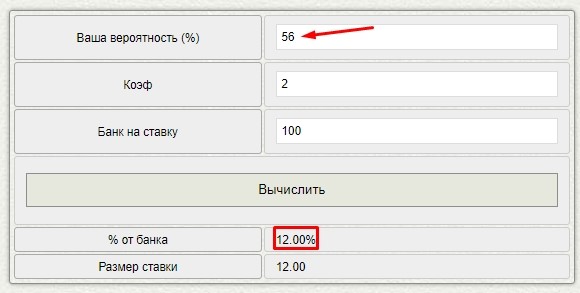
As we see, it results in a fairly substantial percentage of the current bankroll. More than with flat betting. We recommend reducing bets at first. Yes, profits will be smaller, but still greater than with flat betting. The main thing is to protect your bankroll from major drawdowns.
Conclusions
Value bets are a solid betting strategy at the beginning or end of a season, because matches become more unpredictable then. Pay special attention to markets with high odds, and calculate bet sizes using the Kelly Criterion.