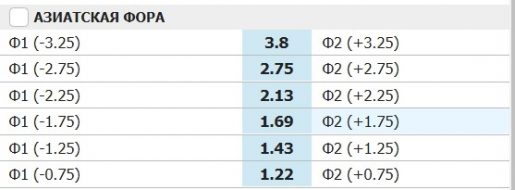
Asian Handicap is one of the most interesting markets in the bookmaker’s lineup. In this article, we will explain what Asian Handicap and total are, how they are used, and what their advantages are compared to other markets.
What is Asian Handicap?
Asian Handicap is similar to the handicap used, for example, in sports betting on basketball or tennis.
For easier understanding, let’s take an example with a spread of (-0.25). In this case, the bettor essentially places two bets on standard spreads: -0.5 and 0. And the total amount is split in half. Accordingly, the winnings are calculated as the sum of the two bets on F(-0.5) and F(0) based on the respective odds in the bookmaker’s line.
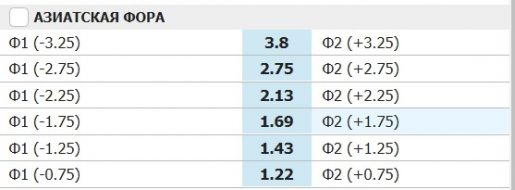
If the home team simply wins, the entire bet will be a winner. If it’s a draw, the first half-bet with F(0) is settled at odds of 1, and the second one is a loss.
Asian Handicap +0.25. If the chosen team wins, the bet is fully won. In case of a draw, half of the bet is returned to you, and the other half is won. If your team loses, your bet loses.
Asian Handicap -0.75. Another type of Asian Handicap. Here, it is split into two standard spreads: F(-0.5) and F(-1). Bets are settled individually, just like in the previous case.
If the chosen team wins by one goal, the first half-bet is a winner, and the second one is returned. All Asian Handicaps increase proportionally by a quarter: (-1.25, -1.5, -1.75, -2, and so on). They are all calculated the same way as these basic handicaps we explained.
Asian Totals
Besides the classic Asian Handicap, there are also totals. In this article, we will explain in detail what an Asian total is, how to use it effectively, and what its advantages are compared to other types of goal-based bets in sports wagering.
At the beginning of this article on Asian Handicap, we explained the advantages of this type of handicap, especially in situations where the final result is a draw, so there are no losing tickets, and the money is returned to the player. Similar to Asian Handicap for the final result and in the goals market, there are some specific features.
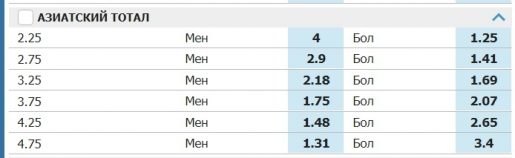
In the standard lineup, there might be two options. To make it easier to understand, we’ll explain using a football example. So, for a football match in the regular goals market, the bookmaker offers two options: under 2.5 goals (0–2 goals in the match) and over 2.5 goals (3 or more goals in the match). When you opt for an Asian Handicap on goals, you have many more choices. Here are the options:
Over / Under 2.25 goals. Just like with Asian spreads, quarter fractions are used here. When a bettor wagers on over / under 2.25 goals, they are essentially placing two bets: half on over / under 2 goals and half on over / under 2.5 goals. Here’s an example:
You place a bet on the Arsenal vs. Chelsea match for over 2.25 goals at odds of 1.90 with a stake of 100 units. If the match ends with three or more goals, the bet wins, and the total payout is 190 units. If the match ends exactly with two goals, the bettor loses half the amount, and the other half is returned to the balance. If the teams score nothing or just one goal, the bet loses entirely.
If the bettor wagered on under 2.25 goals in the same game, with zero or one goal, their bet wins, earning 190 units. If exactly two goals are scored, half the bet is returned to the player, and the other half is lost.
Over / Under 2.75 goals – the bet is split into two standard totals: 2.5 and 3.
Suppose the bet is placed at odds of 1.9 for 100 units. If the match ends with four or more goals, the bet wins, and the total payout is 190 units. If the match ends exactly with three goals, half the bet is returned to you, giving you 1.90 * 50, which is 45 units, and the other half yields a profit of 145 units.
If two or fewer goals are scored, your bet loses, resulting in a loss of 100 units. If the bettor wagered on under 2.75 goals in the same game and exactly three goals are scored, they lose half the money, and the other half is returned to the balance, resulting in a net loss of 50 units.
Over / Under 3 goals. This is a standard total, with rules that are the same regardless of how large the line is (over / under 1, 2, 3, or perhaps 4). When dealing with whole totals, the settlement rules are very clear. We’ll show this with an example of the «Over / Under 3 goals» line.
Suppose a bettor places a wager on the Arsenal vs. Chelsea match for over 3 goals at odds of 1.90 with a stake of 100 units. If the match ends with two or fewer goals, the bet is considered a loss. If it ends with four or more goals, your bet wins. If the match ends exactly with three goals, your bet is returned in full.
The same rules apply to an under 3 goals bet, but reversed. So, under three goals is a winning bet, over three goals is a losing bet, and exactly three goals means the bet is returned.
In addition to the goals market for the final result, there is also a market for the number of goals in halves with identical rules as for the overall result.
Conclusion
It’s simply impossible to overstate how important it is to understand and properly use Asian Handicap and totals. After all, this type of handicap gives bookmakers great opportunities and provides them with insurance in case of a specific number of goals, so we strongly recommend that, if possible, you always choose Asian Handicap over simple goal bets.