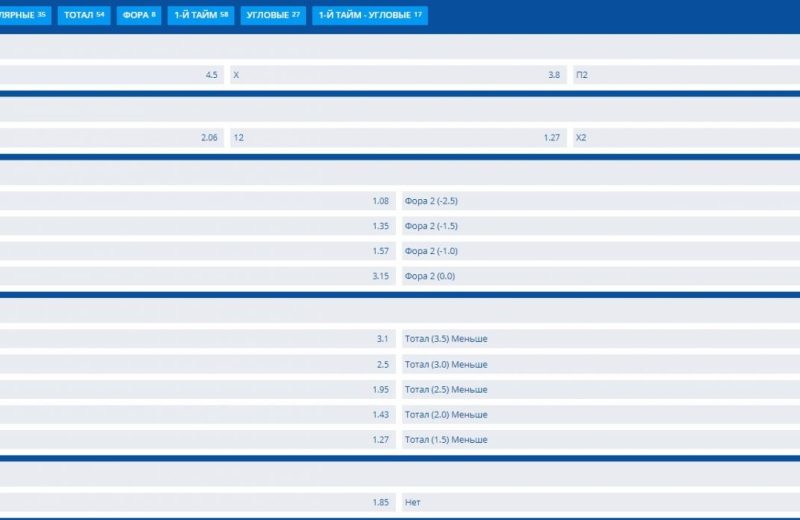
Everything we see on the pages of bookmakers is the line and the odds. The line includes the sports, tournaments, and matches. The odds are the outcomes offered for a specific match. Depending on the importance of the upcoming event, the odds can range from 2 outcomes (just wins) to several thousand (for major tournaments like the Champions League final). Naturally, bookmakers use their own notations, which most players know, but newcomers might find them confusing. So, here’s a breakdown of all the abbreviations and terms used by bookmakers, with explanations and examples. Let’s dive in.
Decoding Values in Bookmakers for Betting
Main Outcomes
In any bookmaker, the main outcomes are listed first, as they are the most popular. Here’s how they look:
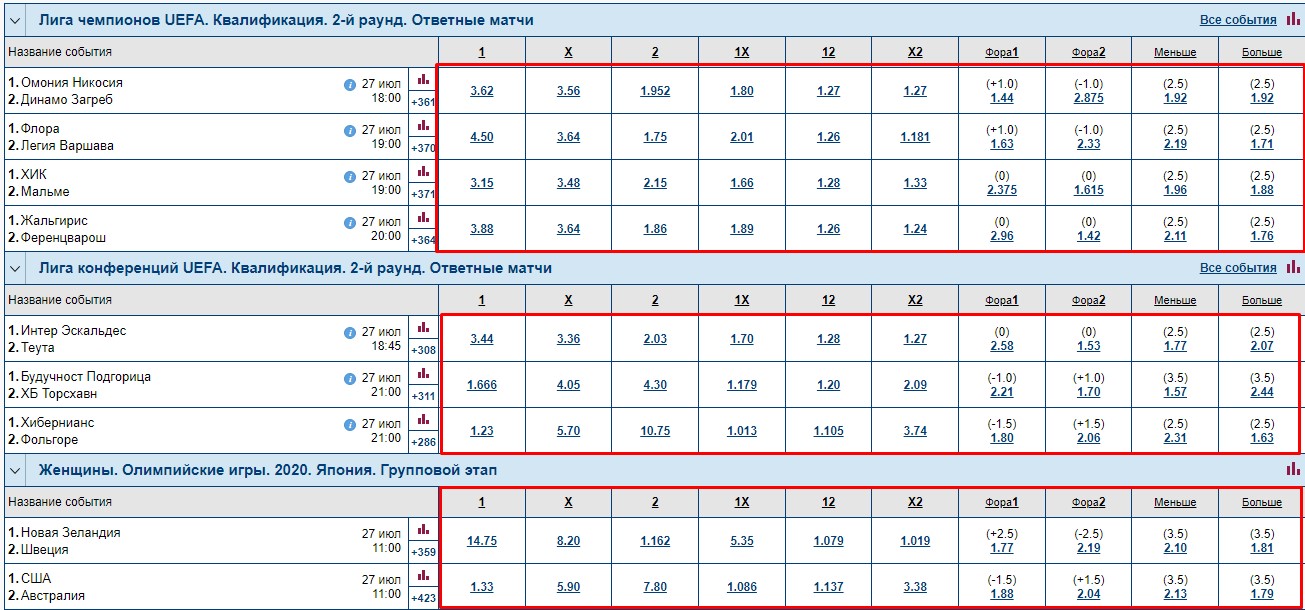
Let’s break it down. We’ll use the first match in the list as an example: Omonia vs. Dinamo Zagreb. So, block #1:

In the highlighted box for the match Omonia vs. Dinamo Zagreb, there are 3 values: 1, X, and 2. What do they mean?
- 1 — This is the win for the first team. In this case, the first team is Omonia.
- X — This is a draw (in all sports, it means a draw in regular time, without considering hockey overtimes or other extra times).
- 2 — This is the win for the second team, in this case, Dinamo Zagreb.
Additional nuances. In some bookmakers, instead of ‘1’ and ‘2’, they might use ‘P1’ and ‘P2’ or ‘Win 1’ and ‘Win 2’. In sports like volleyball, tennis, table tennis, and others, there is no ‘X’ option, as draws don’t occur in these sports.
Double Chance
Moving on.
 Before us is the second block, with combined bets: 1X, 12, and X2. This is almost the same as the first block, but a bit safer, hence the lower odds. We already know these values from the first screenshot. What do they mean in a combined format?
The block is called ‘Double Chance,’ which means that for the bet to win, one of the two combined outcomes needs to happen. It might sound unclear, but an example will clarify. So, we have 3 bet options:
- 1X. We know that ‘1’ is the win for the first team, and ‘X’ is a draw. So, for the bet to win, the first team needs to win or draw.
- X2. ‘X’ is a draw, ‘2’ is the win for the second team. For the bet to win, the second team needs to draw or win.
- 12. ‘1’ is the win for the first team, ‘2’ is the win for the second team. For this bet to win, one of the teams needs to win. This bet is also known as ‘No Draw’.
Additional explanations. This block only appears in sports where a draw is possible. In some bookmakers, it’s not highlighted in the main outcomes and is deeper in the odds. Sometimes it’s renamed; for example, ‘1X’ might be called ‘First Team Won’t Lose’, and ’12’ as we mentioned, ‘No Draw’.
Handicaps
Handicaps can also be called handicaps or simply ‘F’. Just like in childhood when we give you a 2-goal head start, here we bet on a team winning with a specific handicap.
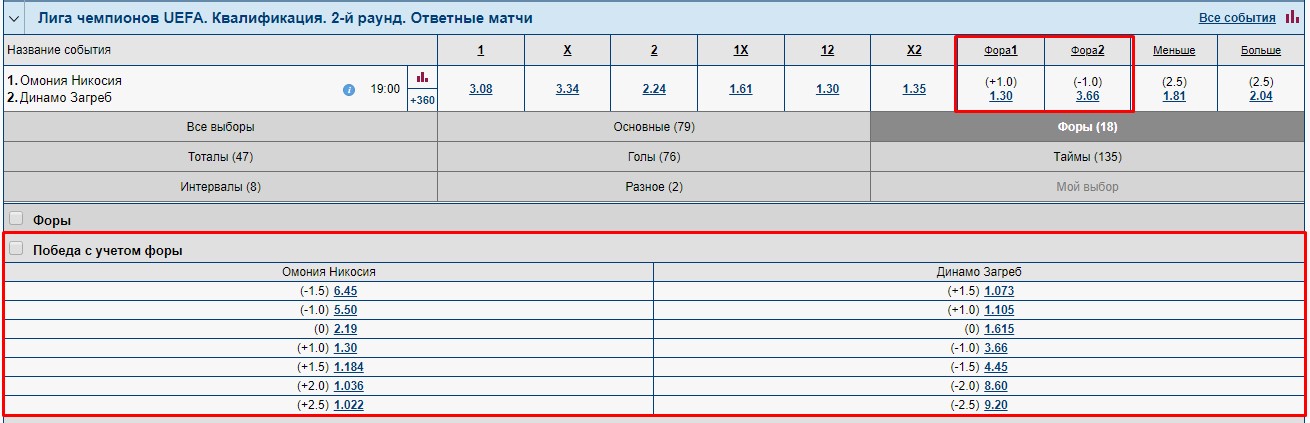
What do you need to know about this bet type? First, that we get to choose which team’s overall win we’re betting on. Handicap 1 means we need the first team to win, Handicap 2 means the second team. Some bookmakers show the full breakdown right away, like not ‘Handicap 1 (+1.0)’ but ‘Handicap Omonia (+1.0)’.
Let’s quickly explain how it works and show an example.
Our match is Omonia vs. Dinamo Zagreb; nothing changes. In the main line, they offer Handicap 1 (+1.0) and Handicap 2 (-1.0). Handicap 1 means we need Omonia to win. With a handicap of +1, we add this number to the initial score (from 0:0). So, we start with Omonia leading by 1 goal virtually.
In the case of the opposite, which is Handicap 2 (-1.0), we need Dinamo Zagreb to win, but they start with a -1 goal deficit. To make it easier, first master fractional handicaps, then whole ones, and finally Asian ones. That’s what we’ll do.
Fractional Handicaps
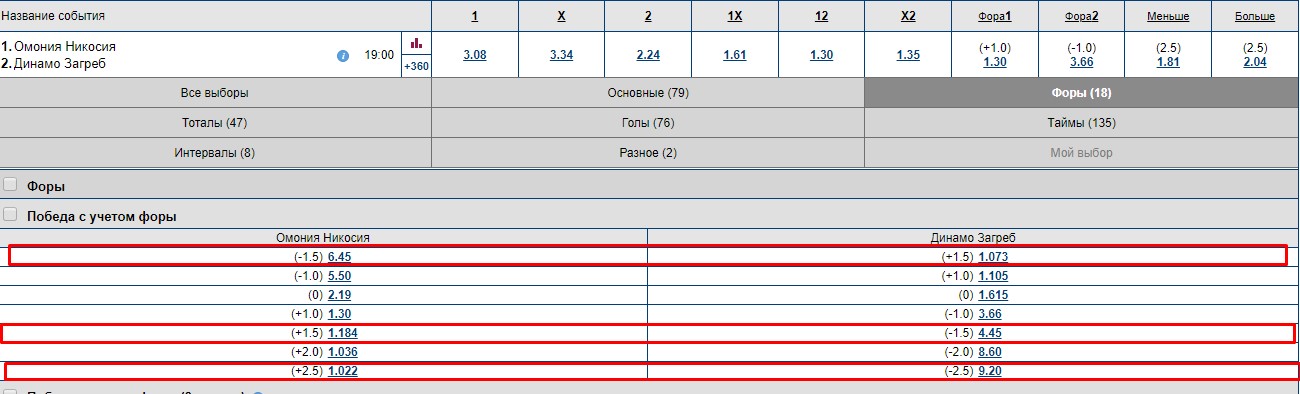
For this match, there are 3 pairs of fractional handicaps: Handicap 1 (-1.5), Handicap 1 (+1.5), Handicap 1 (+2.5), Handicap 2 (+1.5), Handicap 2 (-1.5), Handicap 2 (-2.5).
Which bet will we take? Let’s say Handicap 2 (-1.5). This means Dinamo Zagreb starts down by 1.5 goals. What results would satisfy us now?
| Match Result | Dinamo loses by 1 goal, say 1:0 | Draw, say 2:2 | Dinamo wins by 1 goal, say 1:2 | Dinamo wins by 2 goals, say 0:2 | Dinamo wins by 3 goals, say 1:4 |
| Bet Result | Omonia has 1 goal, Dinamo has 0 minus 1.5. Final score 1:-1.5. 1 is greater than -1.5, bet loses | Omonia has 2 goals, Dinamo has 2 minus 1.5. Final score 2:0.5. 2 is greater than 0.5, bet loses | Omonia has 1 goal, Dinamo has 2 minus 1.5. Final score 1:0.5. 1 is greater than 0.5, bet loses | Omonia has 0 goals, Dinamo has 2 minus 1.5. Final score 0:0.5. 0.5 is greater than 0, bet wins | Omonia has 1 goal. Dinamo has 4 minus 1.5. Final score 1:2.5. 2.5 is greater than 1, bet wins |
Similarly, a positive handicap works. To summarize:
- If we take a negative handicap, we subtract the handicap amount from the chosen team’s goals.
- If we take a positive handicap, we add the handicap amount to the chosen team’s goals.
- The bet is on the team corresponding to the number. Handicap 1 means betting on the first team’s win, Handicap 2 on the second team’s win.
Whole Handicaps
Here’s what whole handicaps the bookmaker offers for this match.
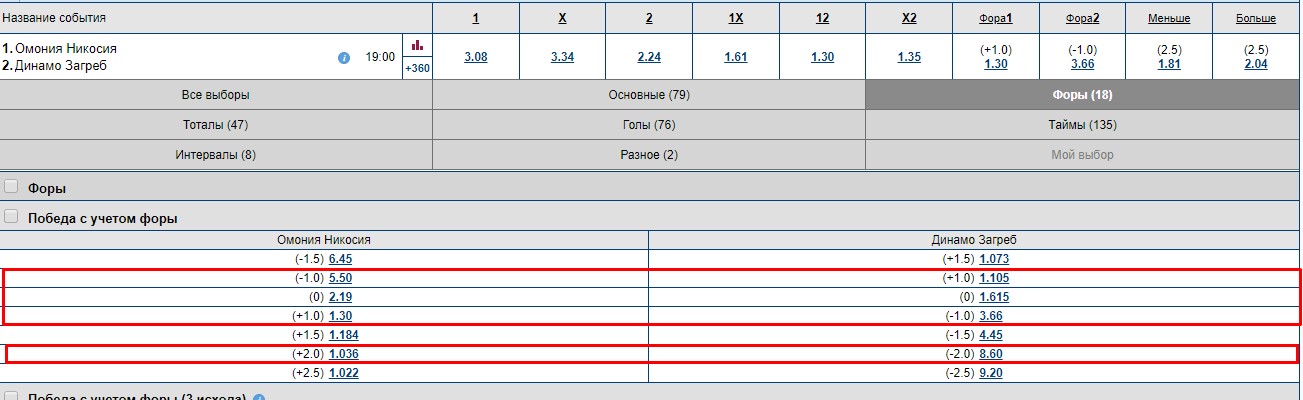
What’s the difference? The difference is that with the handicap, a draw is possible. For example, if we take Handicap 1 (0) at odds of 2.19, and the teams draw 2:2, we add 0 to the first team’s score, resulting in 2:2. If the handicap leads to a draw, the bet is returned.
For example, if we take Handicap 2 (+1), we need Dinamo Zagreb to win, starting with a 1-goal lead. If Omonia wins 3:2, we add 1 goal to Dinamo, making it 3:3—a return. If the score is 4:4, adding 1 goal to Dinamo means a win.
Over time, you’ll understand the following:
- Handicap 1(0) — This is something between betting on Win 1 and 1X. With Handicap (0), a draw means a return; for a win, the team needs to win. The odds for Handicap 0 are usually between Win 1 and 1X.
- Handicap (-1) — Means the team needs to win by 1 goal for a return and by 2 or more for a win.
- Handicap (+1.5) — Means the team can lose by 1 goal and still win the bet.
- Handicap (+2) — Means the team can lose by 2 goals for a return. Anything worse than losing by 2 goals means a loss.
Asian Handicaps
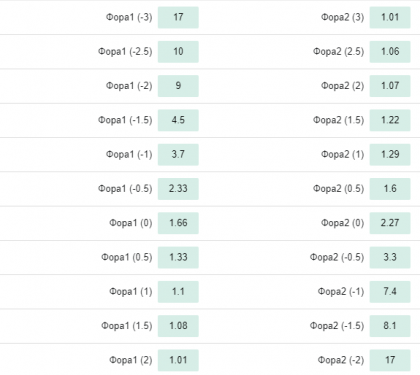
Here’s how Asian handicaps look. They always end in 25 or 75.
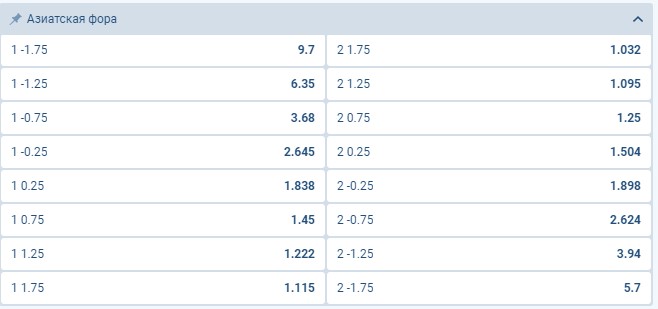
We already discussed zero handicap, whole, and fractional ones. Asian handicaps are a combination of two handicaps. It sounds scary, but let’s use an example.
The first on the screenshot is handicap -1.75. What do we need? We add 0.25 to each side. So, -1.75 turns into two bets: -2 and -1.5. And we already explained how -2 and -1.5 work. The same applies to the others.
- +1.75 = +2 and +1.5.
- -1.25 = -1.5 and -1.
- +1.25 = +1.5 and +1.
- -0.75 = -1 and -0.5.
- +0.75 = +1 and +0.5.
I think the method is clear.
The special thing about these bets is that the total amount bet, say on Handicap 1 (-1.75) at odds of 9.7, is split in half. As we said, Handicap 1 (-1.75) is two handicaps: H1 (-2) and H1 (-1.5). So, if you bet 1000 rubles, 500 goes to H1 (-2) and 500 to H1 (-1.5). If the team wins by 2 goals, H1 (-2) returns, and H1 (-1.5) wins. With odds of 9.7, you get 500 from the return and 500*9.7 = about 4850 rubles. In total, 5350 rubles on your account.
Total
Let’s sort out totals. For example, take the Galatasaray vs. PSV match.
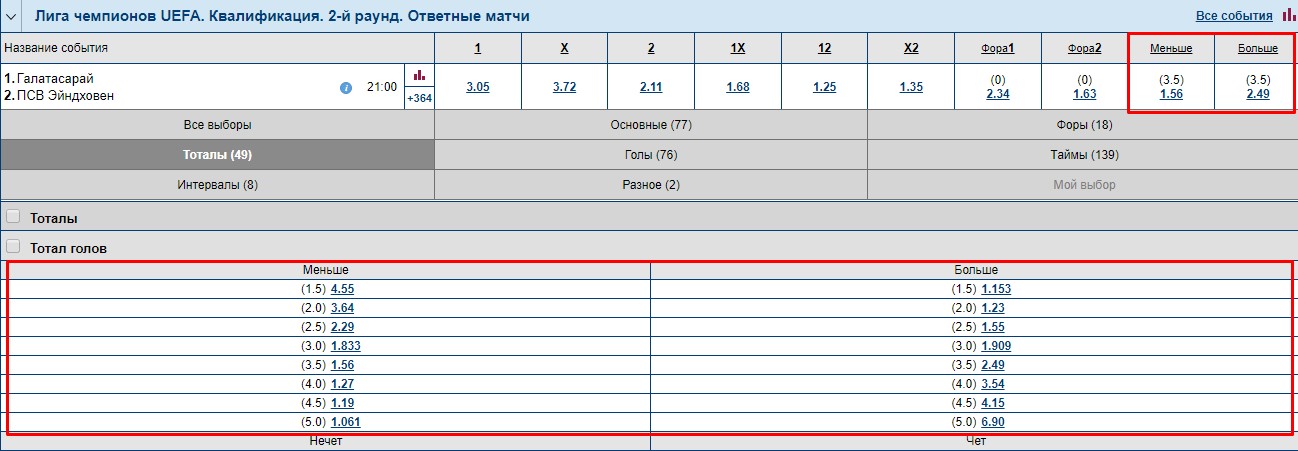
Here’s how they look. Total is the overall scoring value. In soccer, it’s the total number of goals; in hockey, pucks scored; in basketball, points scored (including overtime); in tennis, games; in volleyball, points.
Inside the odds, you can find additional totals, like total corners, total fouls, total yellow cards, and so on. There are also individual totals—the total goals, pucks, games, sets, or points from a specific team or player.
Totals come in two types:
- Total under (in our example, total under 3.5 at odds of 1.56).
- Total over (in our match, total over 3.5 at odds of 2.49).
Some bookmakers use abbreviations:
- Total over = TO or over.
- Total under = TU or under.
In our example, for TU 3.5, they offer 1.56. For the bet to win, the teams need to score less than 3.5 goals total. So, scores like 0:0, 1:0, 0:1, 1:1, 0:2, 2:0, 1:2, 2:1, 0:3, and 3:0 would win, as they have at most 3 goals. We bet on less than 3.5, so it matches.
Accordingly, for TO 3.5 to win, the teams need to score 4 or more goals: 2:2, 3:2, 0:4, and so on.
Whole Totals
As with handicaps, there are whole, fractional, and Asian totals. We already covered fractional, now for whole.

Whole totals are those where the numerical value is a whole number, like TU 2, TU 3, TO 4, TU 5, and so on. Let’s break it down with an example.
Say we bet on TO 2 at odds of 1.23. What happens?
- If less than 2 goals are scored (0 or 1), the bet loses.
- If exactly 2 goals are scored, the bet is returned.
- If 3 or more goals are scored, the bet wins.
Asian totals work similarly. If you forgot, scroll up to the Asian handicaps section. You’ll get it.
Individual Totals
Individual totals are quite popular betting markets. They let you bet on the scoring of a specific team, ignoring the overall match result. In simple terms, it doesn’t matter how many the team concedes; what matters is how many they score as needed.
Individual totals have different names at various bookmakers. The common name is individual total. Alternatives include ITB (individual total over) and ITM, individual total for Galatasaray and individual total for PSV, total for Galatasaray and total for PSV.
On Marathon, which we’re using for screenshots, it’s called ‘Total Goals (Galatasaray)’ and ‘Total Goals (PSV)’.

How does it work? For example, we bet on total goals for Galatasaray under 1.5. We have two options:
- Galatasaray scores 0 or 1 goal—the bet wins.
- Galatasaray scores 2 or more goals—the bet loses.
For this bet, the final score, who wins, and the margin don’t matter. The bet is on one team’s scoring, and other factors are irrelevant.
Half/Match
Half/Match bets are quite interesting. They’re especially popular in matches between favorites and underdogs. Let’s take Ludogorets vs. Mura as an example, where the home team is the clear favorite.
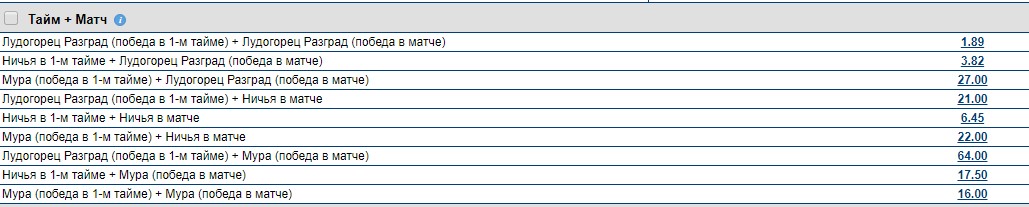
This is a kind of combined bet where you need to predict the outcome of the first half and the full match (the whole match, not just the second half).
Say we bet on the first option: Ludogorets (win in the 1st half) + Ludogorets (win in the match) at 1.89.
If Ludogorets wins the first half 1:0 and the second half ends goalless, we win. If Ludogorets doesn’t win the first half, there’s no point watching further. In general, it should be clear. The first part of the bet is the first half result, the second is the full match result. The only confusing part might be how it’s displayed on different bookmakers.
On our screenshot, the bet is called ‘Half + Match’. On others, it’s often ‘Half/Match’.
In the odds, it’s detailed what we need for a win. Most bookmakers shorten this info. For example, our bet at 1.89 is often called W1/W1 or Win1/Win1. The format is clear. Bet type—Half/Match, bet—W1/W1. So, we need the first team to win the first half and the first team to win the full match.
Other Popular Markets
In the bookmaker’s line, there are another dozen popular markets that experienced players often bet on. However, they likely don’t need additional explanations.
- Galatasaray to score — yes/no. Simple. Bet on ‘yes’, see a goal, and collect the win. No goal—loss.
- Exact score. Also very straightforward. Pick a score from the list, say 1:3. If the match ends that way, you win; otherwise, you lose. Note that some bookmakers offer a return on exact score bets if the match ends 0:0. Check the ‘Promotions’ section of the specific bookmaker.
- Half bets. The same bets as before (outcomes, handicaps, totals, individual totals, etc.), but for the first half or second half only.
- First to… The bookmaker offers bets on who gets the first card, corner, goal, substitution, and so on. It’s all straightforward.
- Intervals. Almost like half bets, but the bet is on a specific segment chosen by the bookmaker, like minutes 1-15: who wins it, if there’s a goal, etc.
- Goals. Besides total goals, you can bet on the exact number of goals (overall or for a specific team).
Combined Bets
Bookmakers offer several types of combined bets with high odds. The idea is to bet on two outcomes at once, and both need to hit.
Basically, combinations are made from these bets: W1, X, W2, 1X, 12, X2, TO, TU, both teams to score, ITB, ITM. Bookmakers usually take two bets and combine them, for example:
- W1 and both teams to score (needs the first team to win, with each scoring at least one goal).
- TO (2.5) and draw (needs a scoring draw with more than 3 goals total).
- W2 and TU (3.5) and so on (needs the second team to win, with total goals under 3.5).
Accumulator
To wrap up this article, we’ll cover accumulator bets. These are combined bets with multiplied odds, allowing you to win big with a small stake. However, all selected outcomes in the accumulator must win or return. If even one loses, the whole bet loses.
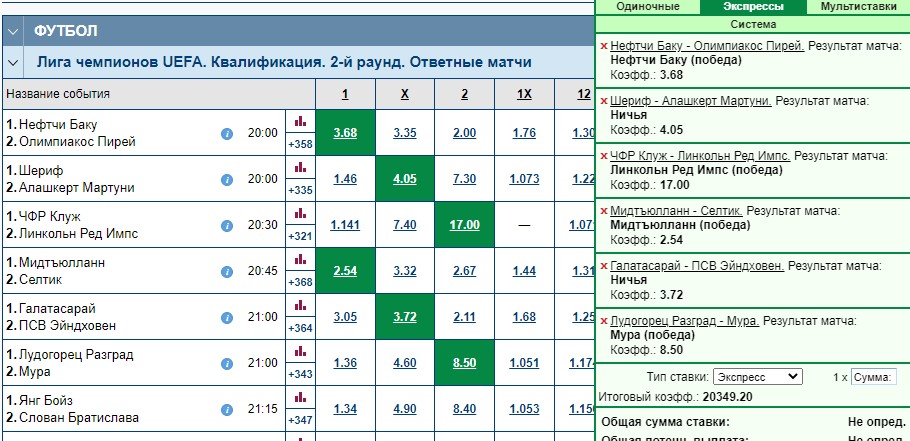
We selected 6 outcomes, two of which are upsets with high odds. In the slip on the right, we see our final odds—20349.20. This means that with a 1 ruble bet, we’d win 20349 rubles, but all 6 matches need to hit.
We’ll cover other bet types like ‘Multi Bets’ and ‘Systems’ in other articles. That’s it for now. If you have questions, leave them in the comments here or ask on the forum.