Football is the most popular sport for betting, both in terms of the number of bets placed and the turnover of funds. One of the most popular markets in this segment is betting on totals. Let’s discuss them.
What is a Total
A total, in itself, is the overall quantity of something. For example, the main total in football is based on goals scored, but there are also totals for corners, shots, possession, cards, and so on.
Example. A bet on over 2.5 means that the teams together must score more than 2.5 goals (3 or more). Some bookmakers call these bets differently (Over, TB).
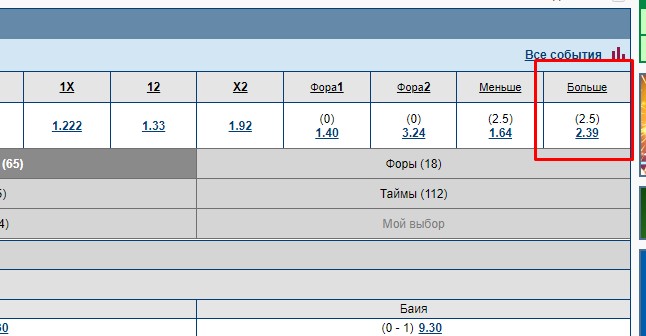
Main totals come in two types:
- Overall. This is the total for both teams, as shown in the screenshot above. In our example, both teams together must score more than 2.5 goals. We’re satisfied if one team scores 3 or more, and the other scores none.
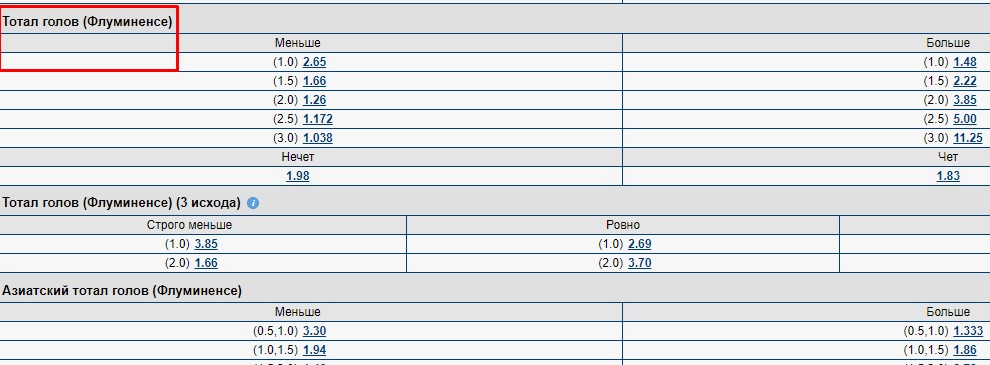
- Individual. This is the total for a specific team. For example, we take the individual total of goals for Fluminense over 1.5 at odds of 2.22 (in the screenshot). That means we need Fluminense to score at least twice. It doesn’t matter who wins or by what score; the key is for Fluminense to exceed 1.5 goals.
Predicting totals is not the easiest task. It requires not just gathering information, but also analyzing it properly.
How to Predict Totals in Football
Professionals have their own methods for predicting totals. Below, we’ll list the key points that experienced bettors pay attention to.
- League Analysis. There’s nothing scary or complicated here. Just open the league table for any championship, like the RPL.
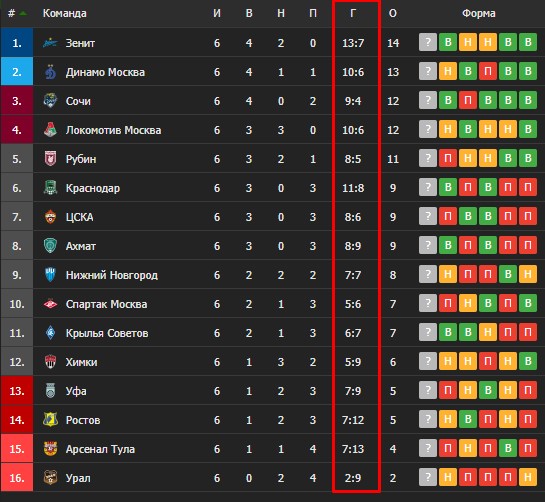
In the goals scored and conceded columns, we only count the goals scored. Zenit has 13, plus Dynamo has 10, plus Sochi has 9, plus Lokomotiv has 10, and so on to the end. Adding them up, we get that in 6 rounds of the 2021/2022 Russian championship, a total of 123 goals were scored (you can recount and verify if you want).
6 rounds and 123 goals. That means, on average, 123 / 6 = 20.5 goals per round.
With 20.5 goals per round, and 16 teams in the league, that means 8 matches per round. So, dividing 20.5 goals by 8 matches, we get an average of 2.5625 goals per game in the current RPL season.
Why are these figures needed? In high-scoring leagues, it’s better to bet on over; in low-scoring ones, on under. But that’s not all, as each league has aggressively attacking teams and defensive ones.
2. Team Analysis. We mentioned earlier that some teams are attacking, while others prefer to decide the match with a single goal. For example, in the Premier League, Manchester City and Leeds can be confidently called attacking teams, and somewhat conditionally, Liverpool and West Ham. But where there are attacking teams, there are also defensive ones. Some are mixed; for instance, Leicester prefers defensive football and scores most of its goals on counterattacks, usually not many. Chelsea also plays comfortably from defense. Meanwhile, Manchester City, which scores a lot, concedes very rarely, so it’s not ideal for totals. On the other hand, Leeds plays recklessly, attacking without regard for their own goal, often leading to high-scoring matches (where over hits).
From these observations, we can conclude that in a Manchester City vs. Leeds match, over 2.5 or even 3.5 is likely to hit, while a Chelsea vs. Leicester game will probably deliver just 2 goals at best.
3. Tournament Situation. Each team has its own goals for the season. Some aim to win the title, others to reach European competitions, and some just to avoid relegation. Everyone has objectives, but towards the end of the season, they don’t matter much. The only factor left is whether a team can reach a higher milestone. For example, can Liverpool catch up to Manchester City, or can Aston Villa climb into the European spots?
When a team has nothing left to fight for at the end of the season, all previous analysis becomes irrelevant. It’s best to skip such matches.
Why does the system break down if a team has no objectives left?
- Lack of motivation. Players just go through the motions until the new season starts.
- Coaches stop risking key players and bring in the reserves.
- They start testing young players to evaluate them for the next season.
These are the key factors that disrupt total analysis. So, we’ll say it again: it’s better to skip such matches, even if one team is motivated and the other isn’t.
4. Suspensions and Injuries. Naturally, every club has professionals, not just anyone off the street. But it’s unfortunate that some teams’ play revolves entirely around specific players. Without them, the team becomes a gray blur, unable to play properly.
Here’s a vivid example.
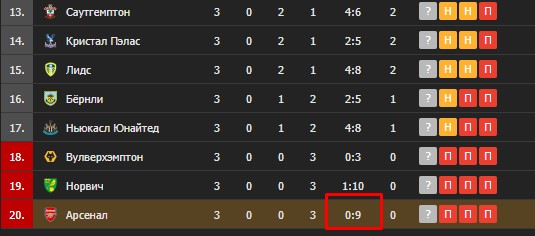
Arsenal hasn’t been considered a top English club for a while. Sadly, their results lately haven’t been impressive, but it’s not so bad that they’d lose 3 matches at the start of the season with a total score of 0:9. A big reason for this is the absence of key attackers Alexander Lacazette and Pierre-Emerick Aubameyang. Without them, the team can’t score, as shown over the last 270 minutes in the Premier League. As a result, it’s best to skip Arsenal matches, since it’s unclear what to expect without their leaders.
Almost every team has such players; without them, the game loses its spark. You need to watch football and understand each player’s importance to their team. Without them, it’s better to pass on total bets.
5. Don’t Rush the Bet. Always wait for the coaches to announce the starting lineup. These details usually appear on various stats sites 30-90 minutes before kickoff.
Why is it important not to rush? It’s simple. You might analyze the entire league for scoring, understand a team’s style, make a solid total prediction, only to find out that Manchester City is suddenly without De Bruyne and Foden, and their opponent Chelsea is without Werner, Lukaku, and Kanté. Admit it, all your analysis goes out the window. Sure, the bet might still win, but then it’s up to fate, and you have no control.
How long should you wait? At least until the lineups are announced, but it’s even better to wait almost until kickoff. Though rare, there are cases where key players get injured during warm-up and drop out of the squad. We don’t need that.
6. Consider Weather Conditions. Unfortunately, the whims of the weather can significantly alter a football match, usually for the worse. This is especially relevant for the Russian championship.
Sudden snow before kickoff automatically lowers potential scoring. As a former player, I know how hard it is to handle the ball in snow and freezing temperatures. It becomes frozen, harder, and slipperier. It’s tougher to control, feels heavier, and you have to adapt, meaning passes and shots will be poorer for a while. Not to mention, players slip on the field, which slows the game and causes fatigue to build faster.
Still, the snow issue is more relevant to Russia. But in other leagues, weather quirks can also make big changes. After all, playing in heavy rain is tough. Simple through balls often go out of bounds on the slippery grass. On the flip side, long shots become a bigger threat, and goalkeepers struggle to hold onto the ball after shots or crosses. Still, keepers have learned to deal with it, often punching the ball away instead. But for outfield players, it’s harder, and scoring usually drops in heavy rain.
Check the weather before the match starts. If it’s acting up, it’s better to skip the game.
7. Skip High Totals. It’s not always worth going for high totals, like over 4.5. Even when an underdog plays a clear favorite, blowouts don’t happen often. Coaches want results and 3 points, so they often try to hold a 1-2 goal lead. You need to know how a team behaves after scoring, say, 2 unanswered goals in the first half. For example, Bayern will keep pressing to finish off the opponent and often hit over. But London Chelsea will give the ball back and likely not concede more than one in the second half.
8. Two Scoring Teams Don’t Always Mean Over. A common mistake for beginner bettors is overloading on over in big team matchups. Say, Manchester City vs. Chelsea. It seems with that talent, they should each score at least twice, making over 3.5 hit. But that’s not how it works. Alongside their ability to score, they also know how to defend or concede very little. Sadly, in modern football, defense often dominates attack. In such matches, it’s usually 1-2 goals, sometimes 3.
In principle, these are all the tips for predicting totals in football. To sum up, we have the following:
- Analyze the league’s stats. Prefer over in high-scoring leagues and under in others.
- Look at team styles, focusing on both goals scored and conceded.
- Study motivation—do the teams have something to play for?
- Check lineups for injured or suspended players.
- Wait until close to kickoff.
- See where the match is and check the weather.
- Don’t overdo it with totals; avoid extremes.
Strategies for Predicting Totals
This might not be full-fledged strategies, but it can serve as a basic guide for betting on totals.
When to Bet on Over?
We need matches that meet two criteria:
- Far from perfect defense.
- Relatively decent attack.
A weak or average defense is more important than a strong attack, because defense dominates attack. Let’s break it down with an example.
On August 27, in the German championship, Borussia Dortmund played Hoffenheim. This was the 3rd round of the Bundesliga.

Before this match, the teams had played 2 games each in the Bundesliga with the following stats for goals scored and conceded:
- Borussia: 6:4.
- Hoffenheim: 6:2.
Impressive numbers, right? Such a match automatically goes for over 2.5. Again, don’t get greedy—over 3.5 at most, not more.
Under 1.5 in the First Half Strategy
There’s an interesting strategy betting on under 1.5 in the first half. Typically, the match is decided in the second half, as teams gradually settle in during the first. But there are a few important points here.
- The odds should be at least 1.55 (ideally from 1.60). These figures are only seen in favorites vs. underdogs matches.
- The favorite should be missing a key starter.
Individual Over on Corners Strategy
Individual total on corners is also an interesting approach, but it requires knowing the team. Here, you need to consider three things:
- The team you’re betting on must be playing at home.
- The lineup should include fast wingers.
- The team’s forward should be physically imposing, so they treat corners as potential goals.
In such matches, home teams often hit individual over on corners.
That’s all for now. Thanks for your attention and good betting!