
Most bookmakers offer Asian handicaps in addition to traditional ones. If you’re interested in the Asian line, you probably already know what a handicap like -1.5 or +2.5 means, so let’s dive right in without delay.
What is the Asian Handicap?
A bit of theory. Traditional handicaps use whole or half numbers.
- Example of whole numbers: Handicap (+2); Handicap (-3) and so on.
- Example of half numbers: Handicap (-1.5); Handicap (+3.5).
Asian handicaps are different because they use ‘quarters.’ Examples of Asian handicaps:

In our example, we no longer see whole or half numbers, but quarters: Handicap 1 (-1.75), Handicap 1 (-1.25), and their opposites. These are what we call Asian handicaps.
Why Use Asian Handicaps?
Asian handicaps are commonly used in sports with low expected scores. This is straightforward—for instance, in soccer, the gap between a handicap of (-1.5) and (-2) can be too wide. Asian handicaps help bridge that gap.
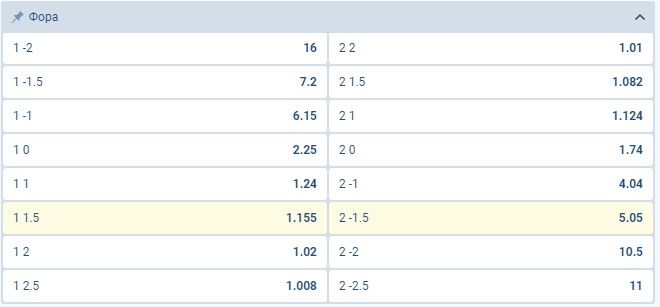
As seen in the screenshot, the odds for (-1.5) are 7.2, while for (-2) they jump to 16. That’s a massive difference. We’ve covered the theory, so let’s break down what an Asian handicap is and what you’re betting on.
Asian Handicap: Example
Let’s look at the match between Rostov and Dynamo, showing the Asian handicaps offered by bookmaker 1xBet.
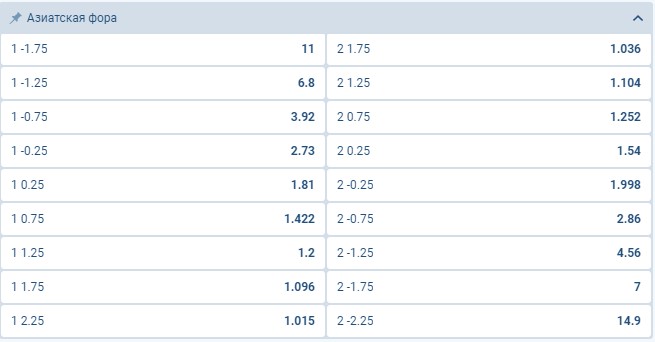
Here, we see Asian handicaps like 1.75, 1.25, 0.75, 0.25, 2.25, and their opposites. At the end of the article, we’ll share a quick tip using Marathon bookmaker, but for now, let’s stick to the explanation.
Take the first handicap from the screenshot: Handicap 1 (-1.75). Suppose you place a bet of 1,000 rubles. Using basic math, round this handicap (-1.75) in both directions by adding and subtracting 0.25. This gives you Handicap 1 (-1.5) and Handicap 1 (-2).
Your Asian handicap (-1.75) turns into two standard handicaps: (-1.5) and (-2). But how and why? You’re placing one bet, yet it splits into two. It’s simple—your 1,000 ruble stake is divided equally, resulting in two bets:
- Handicap 1 (-1.5) — 500 rubles.
- Handicap 1 (-2) — 500 rubles.
That’s how an Asian handicap works. But you might wonder how the odds are calculated, since you’re betting at odds of 11, and it splits into two.
How Odds Are Calculated
You placed a 1,000 ruble bet on Handicap (-1.75) at odds of 11. The odds remain the same—you now have two separate bets of 500 rubles each at odds of 11. Your betting slip looks like this:
- Handicap 1 (-1.5), odds 11, amount — 500 rubles.
- Handicap 1 (-2), odds 11, amount — 500 rubles.
If Rostov wins by exactly 2 goals, you’ll get a refund on the Handicap 1 (-2) bet (500 rubles back), and a win on Handicap 1 (-1.5) (500 rubles * 11 = 5,500 rubles). In total, you’ll have 6,000 rubles in your account.
Alternatives to Asian Handicap
You don’t have to use Asian handicaps; you can just place two standard bets. In our example, we took Handicap 1 (-1.75) at odds of 11. Looking at the line, you could have placed two separate bets: one with lower odds (7.95) and one with higher odds (17).

Marathon Bookmaker to the Rescue
This isn’t an ad, but Marathon is the only legal bookmaker in Russia that doesn’t use ‘quarters’ in Asian handicaps. Their line shows two familiar handicaps instead. Let’s check the screenshot.
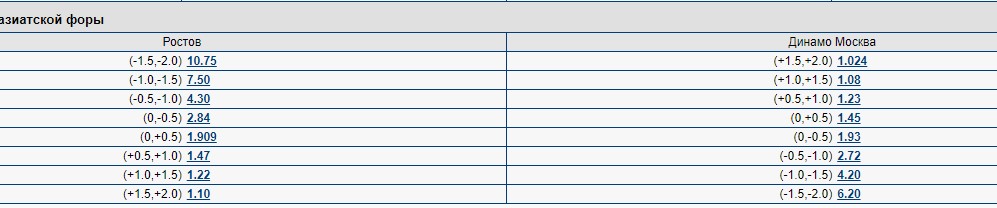
Handicap (-1.5, -2.0) is the same as (-1.75). Handicap (-1.0, -1.5) is (-1.25), and so on. Here, you see two standard handicaps right away, with the stake split equally between them.
Compare this screenshot with another showing the same handicaps in classic Asian format:
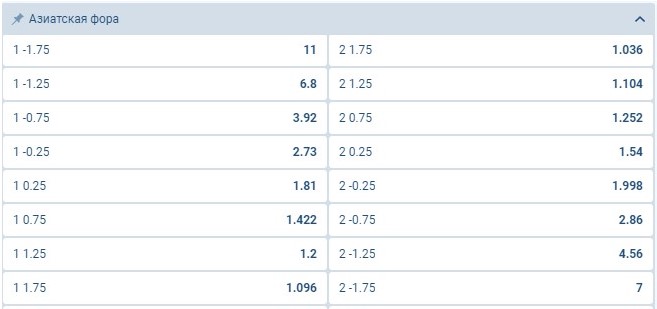
Both screenshots show the same markets in the same order, just presented differently. It’s the same thing, just worded differently. You could save them for reference—if you forget what Handicap (-1.25) means, check the second screenshot, note its position (second in line), then find the second handicap on the Marathon screenshot to see that -1.25 equals a combination of -1 and -1.5.
This can help at first, but it’s easier to just round the Asian handicap in both directions. We’ve also included a conversion table below to clarify what each bet means.
Asian Handicap Conversion Table
| Asian | -0.25 | -0.75 | -1.25 | -1.75 | -2.25 | -2.75 |
| Standard | 0 and -0.5 | -0.5 and -1 | -1 and -1.5 | -1.5 and -2 | -2 and -2.5 | -2.5 and -3 |
Author’s Conclusions
Honestly, I experimented with Asian handicaps when I started. They’re useful for hedging risky bets—for example, if you’re wary of (-1.5), you might go with (-1.25) to get at least half your stake back if the win is by just one goal. But it’s not ideal.
Over time, I realized Asian handicaps don’t add much value. Hedging feels good, but it’s often ineffective. In betting, if you lose, you lose big; if you win with hedges, you win small. Personally, I skip Asian handicaps and totals—they’re not for me. Some more conservative players think the Asian line protects against big losses and helps build your bankroll steadily. As they say, opinions vary as much as people do.